

From the Hand to the Mind
Craft, machines, artificial intelligence, and the changing value of human judgment
SARAH SHIBANI
Sep 21, 2026
I have always believed that some of the most important things we should teach our children are how to think and how to judge. How to question what they are told, how to distinguish between what sounds convincing and what actually makes sense, how to develop discernment, ethics, and respect for themselves and for others.
These things have always mattered. Thinking, questioning and challenging established ideas have shaped human progress throughout history. But lately I have been thinking about how much more important they are becoming because of AI.
And this led me to think about something much older.
For most of human history, we made things with our hands.
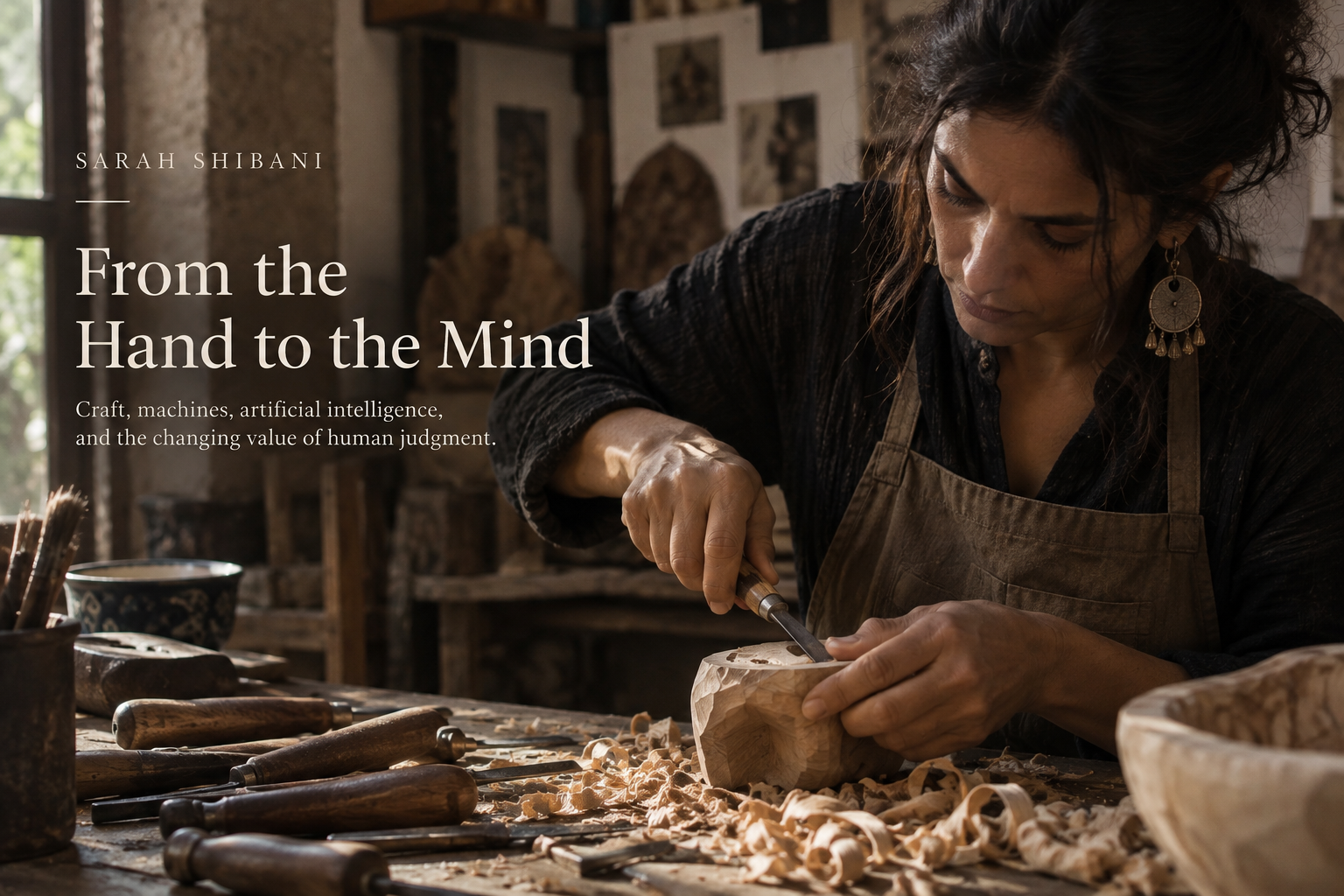
Knowledge lived in the hands as much as it lived in the mind. A carpenter knew wood through years of touching it and working with it. A potter understood clay through pressure, movement and repetition. Weavers, metalworkers, builders, cooks and farmers carried knowledge that could not always be separated from the physical act of doing the work.
This is one of the things that fascinates me about traditional crafts. When a craft disappears, we do not simply lose the objects it produced. We lose a form of knowledge. Sometimes generations of it.
Then came the machine.
Industrialization gradually changed our relationship with work. Machines could produce faster, more consistently and on a scale that human hands could not compete with. Many crafts declined, professions disappeared or changed, and over time enormous numbers of people moved away from making things physically and towards offices, administration and eventually computers.
Our hands did not disappear from work, of course. We still typed, drew, clicked, calculated and designed. But increasingly, the real work was happening somewhere else. The hands became the interface. The value was moving towards the mind.
And now we have invented another kind of machine.
This time, it is not only taking over some of the work of our hands. It is beginning to take over some of the work we assumed belonged to our minds.
AI can write, translate, calculate, summarize, research, generate images, produce ideas and offer solutions. Things that required hours can now be done in minutes or seconds.
Which makes me wonder whether we are witnessing another shift in what we value as human ability.
If machines made physical production abundant, and computers made information easier to process and distribute, AI is now making intellectual production abundant too.
So what becomes valuable when producing something is no longer particularly difficult?
Judgment.
Not simply knowing things, but knowing what to do with what we know. Knowing what is true and what only sounds true. What is useful and what is noise. What is original and what is merely well presented. What deserves to be developed and what should be discarded. What is ethical. What is beautiful. What is worth making in the first place.
In a strange way, the easier AI makes certain forms of thinking, the more important our own thinking becomes.
A person can now produce a perfectly written paragraph without being able to judge whether the idea inside it is any good. Someone can generate a beautiful image without necessarily having developed an eye for beauty. We can receive an answer to almost any question without having learned how to recognize a bad answer.
This is why I keep returning to education.
For a long time, education was built partly around acquiring information and demonstrating that we could reproduce it. We learned facts, formulas, dates, languages and methods because access to knowledge itself required effort.
But what happens when a child grows up with a machine that can retrieve more information than they could ever memorize and produce competent answers almost instantly?
Perhaps the question we should be asking children more often is no longer only, “Do you know the answer?”
It is: Why do you think this is the answer? How do you know? What is missing? What would make you change your mind? Do you agree with it? Is it fair? Is it ethical? Is it worth doing?
There is another part of this that I find important, especially when I think about traditional crafts.
We tend to tell the history of technology as a simple story of progress. A machine arrives, frees us from an older kind of work, and allows us to move on to something more advanced. But looking back at what happened to craftsmanship should make us a little more careful.
We gained extraordinary things through industrialization, but we also discovered later that something had been lost. Handmade objects became valuable again precisely because mass production made objects abundant. We began to appreciate the irregularity of the hand, the knowledge of the maker, the relationship with material and the traces of a human being in an object.
Perhaps something similar will happen with the mind.
When machines can produce endless amounts of competent writing, images, analysis and information, the scarce thing may no longer be production itself. It may be the human capacity to judge it.
There is something almost circular about this.
We moved from relying heavily on our hands, to working through machines, to relying increasingly on our minds through computers. Now we have created machines that can perform part of that cognitive work too.
I do not know whether it makes sense to say that we are “evolving” as a species in the biological meaning of the word. Probably not. But culturally, we seem to be moving through a long transformation in what we ask the human mind to do.
And perhaps the next stage is not about knowing more or producing more. We already have machines helping us do both.
Perhaps it is about becoming better at deciding.
Better at questioning. Better at discerning. Better at understanding consequences. Better at recognizing quality. Better at knowing what should be preserved and what should change.
And this is also why I do not think the answer is to abandon the older forms of human intelligence. Quite the opposite. We should still teach children to make things, to use their hands, to understand materials, to read slowly, to write, to calculate, to remember, even when a machine can do these things for them.
Because every time we outsource an ability completely, we risk losing some of the knowledge contained within it.
The challenge of AI may not simply be learning how to use a new machine.
It may be learning what we should never allow the machine to replace.
