

Why MENA's Next Luxury Advantage Is Cultural Specificity, Not More Marble
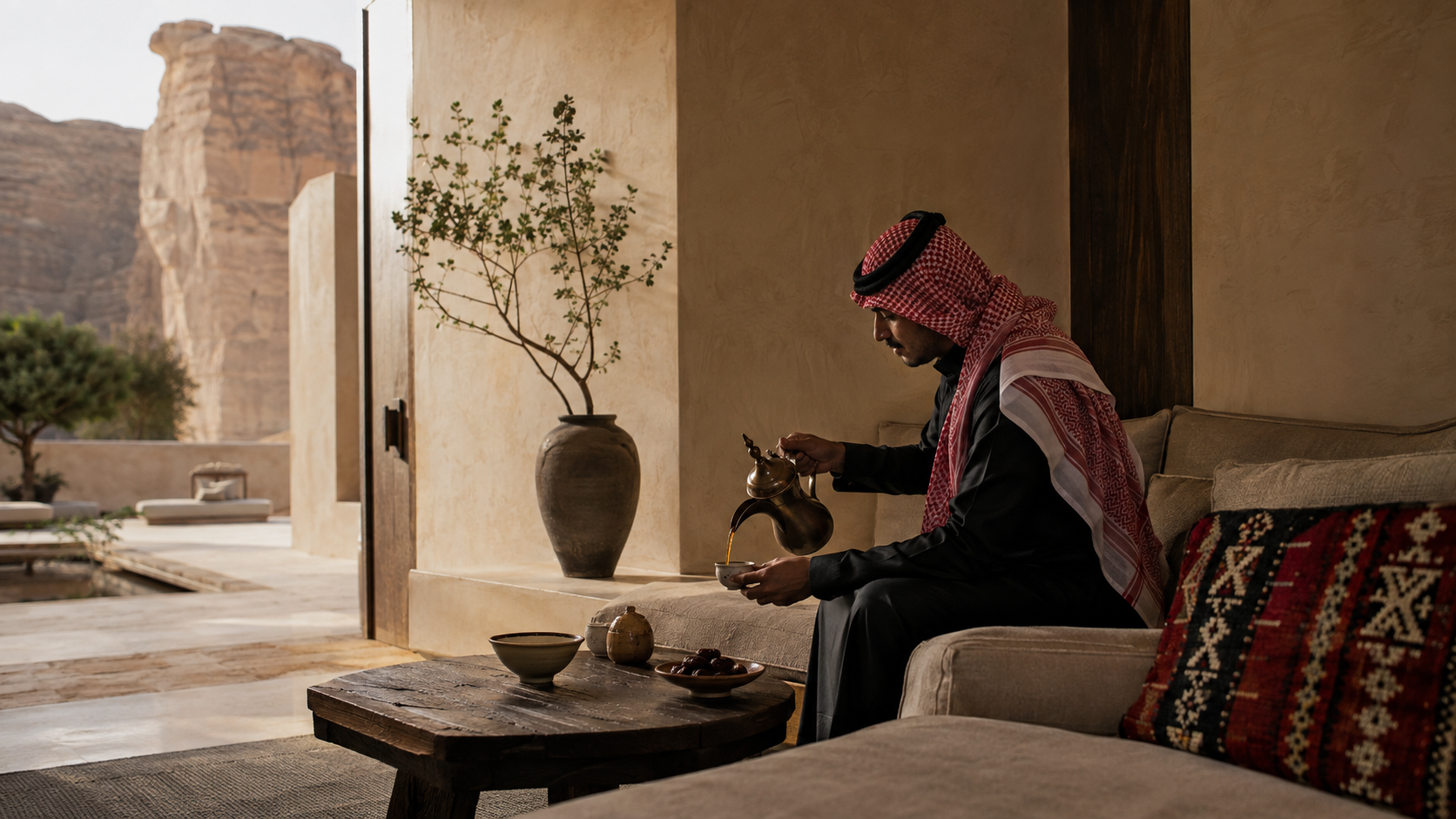
CULTURE, HOSPITALITY & PLACE
For the past two decades, the Middle East and North Africa have become one of the world's most ambitious laboratories of luxury. Cities have risen at extraordinary speed. Hotels have arrived with vast lobbies, rare stone, monumental chandeliers, imported furniture and immaculate finishes. The region has proved that it can build at a scale, pace and level of polish few markets can match.
But as luxury development accelerates, a new problem is appearing: excellence is becoming visually repetitive. A guest can move from a hotel in Dubai to one in Riyadh, Doha or Cairo and encounter different buildings that speak almost the same international language. The marble changes. The chandelier changes. The view changes. Yet the emotional world often does not.
This is not because the region lacks identity. It is because identity is too often introduced late, after the commercial concept, architecture and operating model have already been decided. Culture then becomes a decorative layer: a geometric screen, a patterned cushion, a piece of calligraphy, a date-palm reference or a generic story about East meeting West.
The next era of MENA luxury will be won by properties that reverse this sequence. They will not ask how to make an international hotel look local. They will ask what kind of hospitality could have emerged only from this landscape, this history and these people.
Luxury materials can be purchased. Cultural specificity has to be earned.
The region is approaching aesthetic saturation
The development numbers are formidable. In the second quarter of 2026, the Middle East's hotel pipeline reached a record 724 projects and 178,003 rooms. Luxury alone accounted for 207 projects, while Saudi Arabia led the region with 387 projects. Conversions also accelerated sharply, with the number of rooms involved in brand conversions rising 92 percent year on year.¹
This scale creates opportunity, but it also creates sameness. When hundreds of properties compete for the same affluent guest, marble, brass, oversized floral arrangements and infinity pools stop functioning as differentiators. They become the minimum expected vocabulary of the category.
The paradox is simple: the more luxury is standardized, the less luxurious it feels. True luxury has always depended on scarcity. In a visually saturated market, what becomes scarce is not another expensive material. It is a coherent point of view — a sense that someone understood the place deeply enough to make choices that are specific, deliberate and difficult to imitate.
Cultural specificity is not a style — it is a relationship
Cultural specificity is often confused with traditional styling. A hotel does not become culturally meaningful because it copies vernacular arches or fills its corridors with heritage objects. Nor does contemporary design become placeless merely because it is modern. Symbolic design tells the guest where they are. Culturally specific design lets them feel how that place understands life — and the difference is legible almost immediately, in the body before the mind names it.
Consider the difference between a hotel that installs woven textiles in a guest room and one that has actually thought about how a household in that region prepares to receive a guest: the low table brought out, the specific order in which bread, oil and coffee arrive, the fact that hospitality is a sequence with its own unhurried logic, not a single beautiful object. A room can contain the textile and still get the sequence wrong — serve breakfast on a schedule built for a business traveler in Frankfurt, with a menu that has nothing to do with where the guest is sitting. The textile photographs well. The sequence is what a guest actually remembers.
This is why specificity has to be a system, not a department. It shows up in the pace of a meal, the sequence from shade to courtyard to open sky, the materials that are allowed to age visibly instead of being restored to a permanent showroom finish, the artists who are commissioned, the scent of a public room, the soundscape at dusk, the stories a concierge is actually equipped to tell. None of that belongs to interior design alone. It connects brand strategy, architecture, operations, food, art, programming and communication. Briefed separately, culture fragments into a set of unrelated gestures. Briefed from one proposition, the guest experiences a single coherent world.
Consider Aseer. The opportunity is not to reproduce its painted architectural patterns across a resort. It is to understand the region's relationship with mountains, climate, colour, agriculture, craft, community and seasonal movement — and translate those relationships into spatial rhythm, food, programming and service. SEVEN Abha's opening activations offered a useful signal: regional crafts, local makers, food and community performance were treated as components of the visitor experience rather than background decoration.²
Or consider Cappadocia, where the strongest hospitality concepts do not merely install Turkish objects inside generic rooms. They begin with cave architecture, stone, shadow, topography, village-scale circulation and the region's long history of human adaptation to the landscape. Hilton's first cave hotel, opened there in 2026, is part of a wider movement toward destination-rooted properties that combine local character with international distribution.³
Why this keeps failing — and why "soft branding" isn't automatically the fix
It's worth being honest about why culture keeps arriving last. It isn't because developers and operators don't understand the argument above; most of them do. It's because cultural research is slow, its value is hard to put in a pro forma, and it doesn't photograph for a lender the way a rendering does. Franchise and brand standards exist precisely to de-risk operations at scale, which makes them structurally resistant to the kind of local variation specificity requires. Under real timeline and financing pressure, "make it feel more local" becomes a note added in the last design review — because it's the only stage of the process cheap enough to absorb a late idea.
Global hotel groups have registered this problem commercially, which is part of why collection and "soft" brands are growing so fast — travellers want the trust of an international system without the sameness of a rigid template. In August 2026, IHG introduced its Noted Collection to the Middle East through a conversion in Riyadh, explicitly framed around letting independent hotels keep "individuality and local character" while gaining IHG's commercial platform and loyalty network.⁴
But that framing deserves some scrutiny rather than acceptance at face value. A soft brand can just as easily mean the same standardized operating playbook wrapped in better marketing language — individuality as a positioning line rather than a lived difference a guest can feel at check-in. Whether the Noted Collection and its peers produce actual specificity or a more sophisticated version of sameness will show up in what these properties are allowed to do differently in operations, not in what their press releases say about identity. That is the test worth watching, and it's not yet answered.
For owners, this does change the value of cultural strategy regardless of how the soft-brand question resolves. A property's story is no longer a paragraph written by marketing before opening. It becomes part of the asset itself: the logic behind its positioning, design decisions, art program, restaurant concepts and public identity. The more convincing that logic is, the less the hotel has to compete on price or spectacle alone.
Art must move from procurement to authorship
In many luxury developments, art is still procured after the principal spaces are designed. The remaining walls are measured, a budget is assigned, and works are selected to complete the composition. This can produce elegant interiors, but rarely a cultural position.
Art direction should begin earlier, and ask what the property wants to contribute to the cultural life of its destination. Could it commission new work from regional artists rather than purchase predictable pieces? Could its guestrooms contain editions connected to a wider curatorial narrative? Could its public spaces support residencies, performances, conversations or temporary installations? Could its restaurant tableware become a collaboration with local ceramicists rather than a catalogue selection?
This matters more as cultural districts grow around hospitality. Guggenheim Abu Dhabi's confirmed December 2026 opening will add another major institution to Saadiyat's concentration of museums.⁵ Hotels and restaurants nearby will not compete only for accommodation and dining spend. They will compete for relevance within a sophisticated cultural journey. The strongest hotel is not a sealed object placed in a destination. It is an active institution within the destination's cultural ecosystem.
Restaurants are the most accessible expression of place
A hotel's restaurant often has more cultural reach than its guestrooms. Residents may never book a room, but they can return repeatedly to eat, meet and celebrate. This makes food and beverage one of the most powerful — and most underestimated — tools of destination identity.
The answer is not to make every menu traditional. It is to develop a clear culinary point of view: which landscapes supply the ingredients, which memories shape the dishes, which rituals influence sharing and sequence, which contemporary lives the restaurant actually serves, and what its service style says about hospitality. When cuisine, naming, graphic identity, tableware, lighting, music and staff storytelling emerge from the same idea, the restaurant becomes more than an amenity. It becomes a cultural address — and for boutique properties, often the strongest vehicle for local loyalty and year-round relevance.
What developers and operators must actually change
Cultural specificity cannot be commissioned through a late-stage request to make the project "feel more local." Given the constraints above, it has to be built into the process from the start, not treated as a design-review note:
Begin with cultural research, not a mood board. Study the destination's social rituals, material history, landscapes, contradictions and contemporary creative life before the concept is fixed — while it's still cheap to change.
Write one cultural proposition for every discipline. The brand strategist, architect, interior designer, F&B consultant, curator and operator should be answering the same central idea, not five different ones filtered through their own department.
Distinguish inspiration from extraction. Local craftspeople and artists should be collaborators with authorship, visibility and fair value — not anonymous sources of motifs.
Design operations as carefully as interiors. A culturally specific room can be neutralized by generic music, scripted service and an imported menu. The experience has to survive opening day, and the tenth staff turnover after it.
Measure memory, not only satisfaction. Ask what guests can recall, describe and associate uniquely with the property after they leave — that is the actual test cultural specificity has to pass.
A Turkey–MENA advantage waiting to be built
Türkiye occupies an unusually valuable position in this emerging market. It has deep manufacturing capability, sophisticated hospitality operations, strong craft traditions and extensive experience creating restaurants, resorts and urban interiors. MENA markets, meanwhile, are investing at exceptional scale and searching for identities that can distinguish one new destination from another.
The strongest Turkey–MENA partnerships will therefore offer more than products or execution. They will combine Turkish design and fabrication capacity with locally led cultural research in Saudi Arabia, the Gulf and North Africa. The aim should not be to export a Turkish aesthetic. It should be to build a cross-regional method capable of translating each place on its own terms — which requires humility, since cultural specificity cannot be flown in as a ready-made style. But the systems needed to deliver it — research, narrative development, multidisciplinary briefing, art direction, prototyping and operational translation — can become a powerful specialist service in their own right.
The next competitive question
MENA does not need to prove that it can produce luxury. It has already done so, repeatedly and at extraordinary scale. The more important question now is whether its hotels and destinations can become unmistakable.
The properties that define the next decade will still use beautiful stone, exceptional craftsmanship and ambitious architecture. But those elements will be in service of an idea larger than opulence. They will make guests feel that they have entered a particular cultural world — one with its own memory, rhythm, generosity and imagination.
More marble can make a place more expensive. It cannot, by itself, make it matter.
Sources
Lodging Econometrics, "Middle East Hotel Construction Pipeline Reaches New All-Time High," 13 August 2026. https://lodgingeconometrics.com/middle-east-hotel-construction-pipeline-q2-2026/
Saudi Press Agency, "SEVEN Announces Opening of First Entertainment Destination in Abha," 3 August 2026. https://www.spa.gov.sa/en/N2646665
Hilton, "Hilton Celebrates 100 Hotels in Türkiye," 12 August 2026. https://stories.hilton.com/emea/releases/hilton-celebrates-100-hotels-in-turkiye-with-istanbul-airport-opening
IHG, "Noted Collection to the Middle East with Signing in Saudi Arabia," 11 August 2026. https://www.ihgplc.com/en/news-and-media/news-releases/2026/ihg-introduces-its-new-premium-collection-brand-noted-collection-to-the-middle-east-with-signing-in-saudi-arabia
Solomon R. Guggenheim Foundation and DCT Abu Dhabi, opening announcement, 28 July 2026. https://www.guggenheim.org/press-release/abu-dhabi-announces-opening-of-guggenheim-abu-dhabi
SARAH SHIBANI | AUGUST 2026
